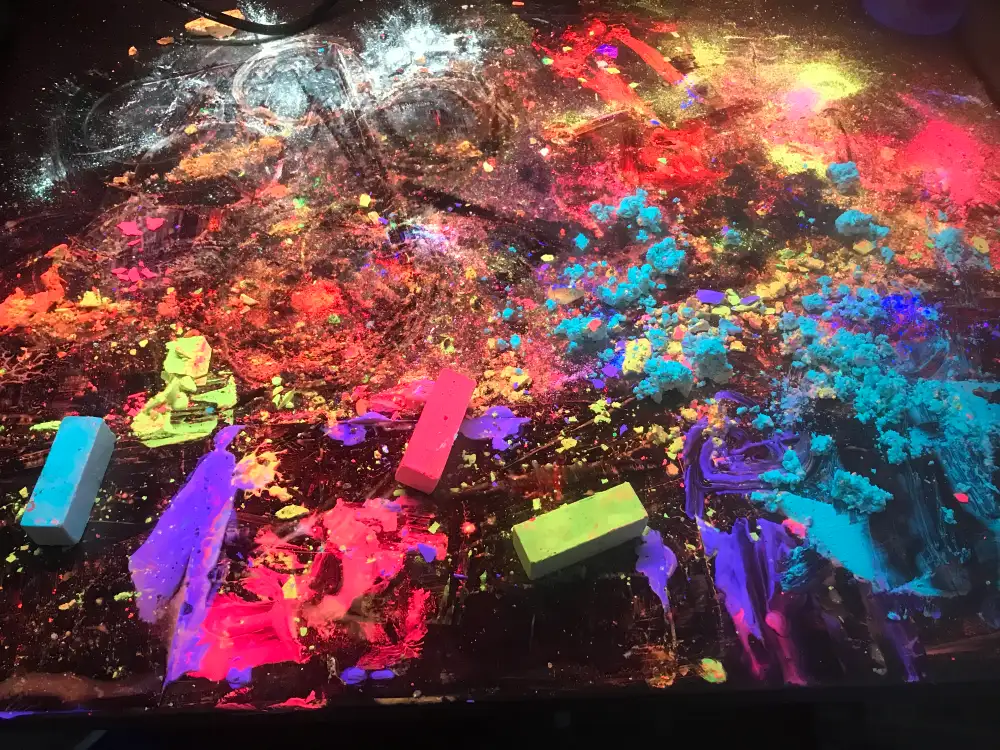
Fluorescent chalk — for outdoor work and high-contrast drawings
All of our chalk is heavily pigmented and reads vividly in normal light. Fluorescent is different because the pigments absorb ultraviolet light — from sunlight or a UV bulb — and re-emit it as visible light. The result is a color that looks noticeably brighter, almost self-lit, compared to a standard color next to it. Under full sun on concrete, the difference is dramatic.
Street painters use fluorescent chalk to make outdoor work hold up against bright pavement. Artists doing daytime presentations use it to pull specific elements forward. If you’ve ever seen a drawing where one figure seems to hover above the rest of the scene in daylight, it’s probably fluorescent pigment doing the work.


Black light chalk — for hidden images and reveals
Black light chalk is invisible under normal light. It only becomes visible when a UV black light bulb is shining on it. Gospel chalk artists have used it since the 1940s to draw a “hidden image” during a presentation — the artist draws the visible portion of the scene in standard chalk, and at the climactic moment the black light comes on, revealing a second image already drawn on the same surface in invisible chalk.
Dr. Karl Steele invented black light chalk in the early 1940s and debuted it at a meeting at the Maranatha Conference Center in Michigan, revealing a fire chariot at the translation of Elijah. Every hidden-image drawing done since is built on that technique.
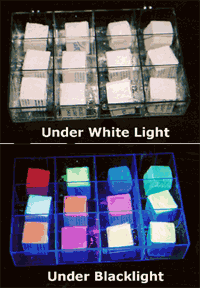
Due to recent industry lighting changes, not all black lights work! Black florescent tubes always will, but here is some information about cutting edge lights from Wildfire Lighting The best black light fixture for producing an optimal effect by john Berardi, Wildfire Lighting Getting the proper black light fixture comes down to two things: output and wavelength. Most lower cost LED black light fixtures on the market today will produce enough output, however their wavelength will typically be anywhere from 390nm and 405nm. While visible fluorescent materials will fluoresce under 390-400nm black light, invisible fluorescent materials will not fluoresce at all. Plus, visible colors that do fluoresce will shift decidedly blue under this longer-wavelength black light. The best black light wavelength to use for the brightest effect and most accurate color rendition of fluorescent materials is 365nm to 368nm So why don’t most manufacturers use a 365 nm LEDs in their products? It comes down to cost. 365nm LEDs are much more expensive than their longer wavelength counterparts and their output per watt is much lower requiring either more LEDs or more powerful LEDs, both at a greater cost. Wildfire Lighting LED black light fixtures are designed specifically to produce the best quality 365nm black light for an optimal effect.